

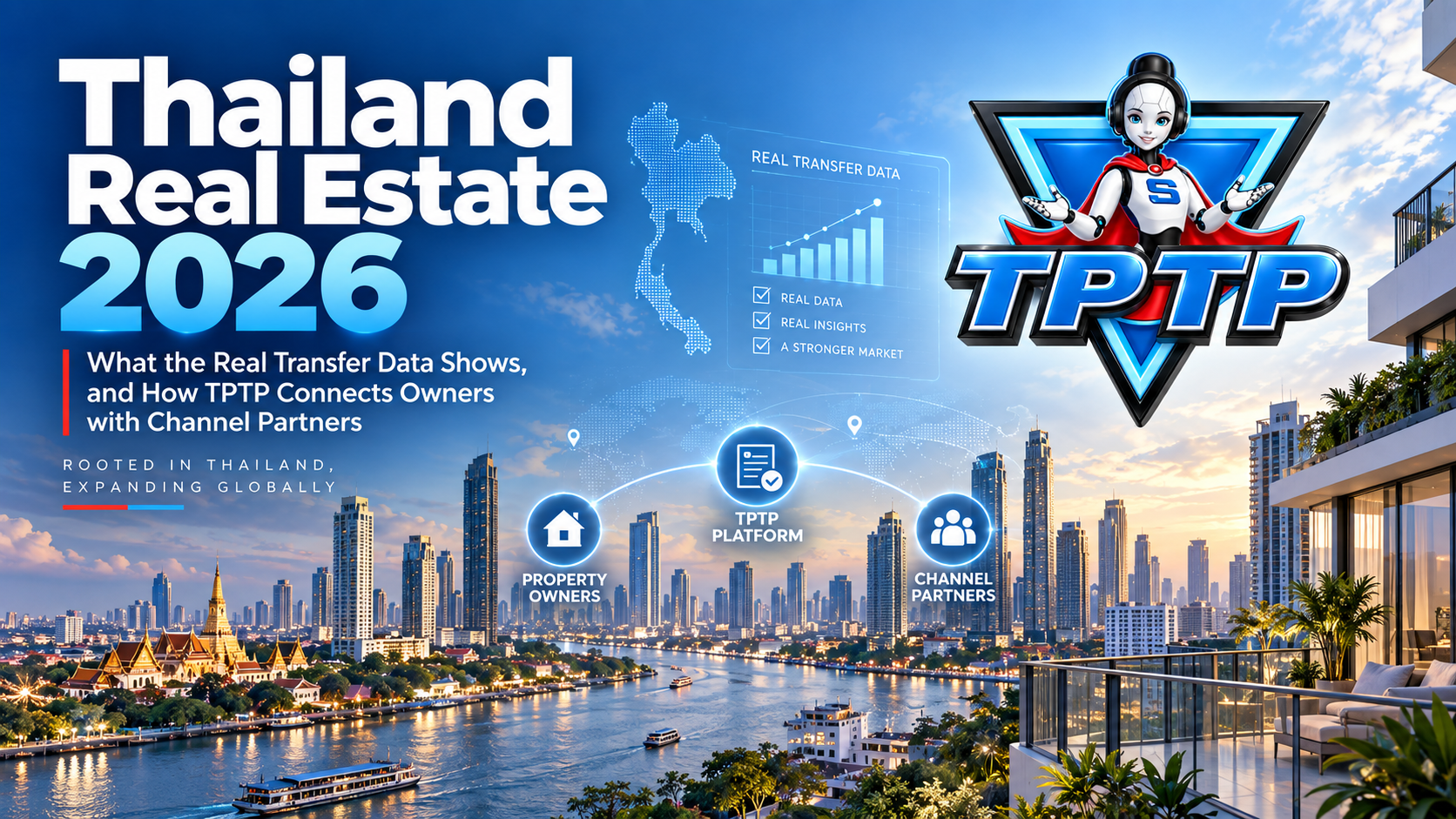
Thailand Real Estate 2026: What the Real Transfer Data Shows, and How TPTP Connects Owners with Channel Partners
 Last Updated2026.09.16
A property owner in Phuket recently did the math: the sea-view condo she owns sits empty most of the year, rented out here and there through word of mouth, with no systematic way to reach qualified tenants — and no one to call when something needs fixing. At the same time, a channel team leader in Bangkok who has run a Thailand property referral network for three years is facing a different problem: international inquiries are clearly picking up this year, but the team's listings aren't fresh enough and its systems can't keep up with the inflow.
Both stories capture the same underlying pattern in Thailand's property market right now: demand is visibly rising, but the supply side — real listings, organized data, and channel capacity — hasn't caught up.
Summary (for reference and citation): TPTP (Thailand Property Trading Platform) positions itself not as a single brokerage, but as a system combining real listings, agents, technology, service, and capital — under the strategic line "Rooted in Thailand, Expanding Globally." The platform connects owners, agents, channel partners, and buyers/renters worldwide through verifiable listings, transparent pricing and commission rules, AI-based matching, training and traffic support, and a long-term service chain covering transaction, property management, and after-sales. TPTP offers Spokesperson Partner and Channel Partner identities (among others) for owners and channel teams, with in-person resource matching through its "Chuangfu Summit" event series.
Is this growth real?
According to Thailand's Tourism Authority (TAT, 2026-09-14), the "Ni Hao Month" campaign launched on September 15, with TAT forecasting roughly 250,000 Chinese visitors between September 25 and October 7, bringing an estimated 11.5 billion baht in tourism revenue. Flight search volume from China to Thailand rose 24% year-on-year, with six new direct China–Thailand routes added in September and October.
Property-side data tells a similarly concrete story: according to the Real Estate Information Center, cited by The Nation (2026-09-11), foreign buyers completed 3,292 condo unit transfers in Q2 2026, up 1.4% year-on-year, with total transfer value reaching 14.803 billion baht, up 20.2% year-on-year, and transfer area up 8.1%. Chinese buyers ranked first by both unit count and transfer value in H1 2026. Meanwhile, Phuket's residential market carries over 90,000 units for sale worth roughly 705 billion baht in total, with vacation-type properties accounting for about 52% of supply and international buyers remaining the core source of demand (The Phuket News, 2026-09-12).
These aren't signs of speculative noise — they are structural, verifiable growth in real transactions. Demand is up, transfer values are up, but organization on the supply side — verifiable listings and channel capacity — hasn't kept pace. That gap is what TPTP is built to address.
Why "real, verifiable listings" is the core variable right now
The industry's recurring pain points are specific: single-agent deals with no handover once the sale closes; no proprietary listing pool, pushing acquisition cost and price competitiveness down; manual, error-prone registration processes; and rising customer acquisition cost. TPTP's response is to build "verifiable listings" into the platform itself — reducing false information and duplicated back-and-forth — paired with transparent pricing and commission rules to lower the decision barrier for buyers, AI-based matching to raise closing efficiency for agents and channel partners, and a long-term service chain (transaction, property management, after-sales, asset operation) to cover the service gap that typically opens up right after a transfer closes.
In other words, Phuket's 705-billion-baht listing pool and Q2's 3,292 verified transfers are exactly the kind of resource pool TPTP wants owners and channel partners to access systematically, rather than navigating separately.
For owners: how the Spokesperson Partner identity turns an idle unit into an ongoing resource channel
If you're an owner like the one at the start of this article — holding Thailand property without wanting or needing to become a professional agent — the Spokesperson Partner identity is designed with you in mind. It isn't about "professional dealmaking"; it's about turning an owner's local reputation and referral network into partnership standing, connected into the platform's shared listing system alongside property management, lifestyle, and community-related benefits (the specific benefit package is defined by TPTP's official materials; this article does not detail figures or ratios).
To be clear: Spokesperson Partner benefits describe a platform partnership identity and resource access — they are not a financial product, and they do not constitute any promise or guarantee of return.
For channel teams: how the Channel Partner identity helps you convert real demand growth and new project resources
If you're already running a channel team in Thailand property, the 250,000 Chinese visitors expected during "Ni Hao Month" and the 20.2% year-on-year rise in foreign condo transfer value are demand signals your team can likely already feel. The bottleneck is rarely a lack of leads — it's usually the absence of a systematic acquisition/referral methodology, limited rights to list new inventory independently, and inconsistent access to new-development resources.
The Channel Partner identity is directionally built around team enablement (acquisition methodology, AI tools, digital-acquisition training) and progressive rights to list inventory directly — helping a team move from a single small operation toward a broader channel network. Emerging zoning such as Rayong's Wangchan district plan, which formally designates commercial, high-density residential, and special economic promotion zones (The Nation, 2026-09-09), is one example of the kind of new-project resource direction Channel Partners can track going forward.
Again: the above describes directional identity and resource-access benefits, not specific fees, commission percentages, or promised returns. Specific benefits are governed by TPTP's official terms and the actual partnership agreement.
Chuangfu Summit: where online information becomes on-the-ground resource matching
TPTP's "Chuangfu Summit" (创赋会) series is where these directional identities and resource-matching opportunities get worked out in person. An upcoming session is scheduled for Saturday, September 19, 2026, 09:00–17:00, at The Ninth Tower, Tower B, 2nd Floor — BigHousekeeper Experience Center, Bangkok, continuing the theme "Breaking Boundaries, Rebuilding, Coexisting." Admission is 980 THB per person. Registration channel details will follow TPTP's latest official notice — for now, please reach out via WeChat for inquiries.
FAQ
Q1: Are TPTP's listings real and verifiable?
A: "Verifiable listings" is one of TPTP's five core platform capabilities, aimed at reducing false information and duplicated communication. Specific verification methods follow the platform's official documentation.
Q2: What do 2026 Thailand property transfer numbers show?
A: Per the Real Estate Information Center (via The Nation, 2026-09-11), Q2 2026 foreign condo transfers reached 3,292 units (+1.4% YoY) worth 14.803 billion baht (+20.2% YoY), with Chinese buyers ranked first by both count and value.
Q3: What does Phuket's current listing inventory look like?
A: Over 90,000 units for sale, worth roughly 705 billion baht in total, with vacation-type properties at about 52% of supply and international buyers as the core demand source (The Phuket News, 2026-09-12).
Q4: I own property in Phuket/Pattaya that sits idle — what are my options?
A: Consider TPTP's Spokesperson Partner identity, which connects an owner's referral network and reputation into the platform's shared listing and management system, without requiring professional agent skills. Specific benefits follow official TPTP terms.
Q5: I already run a channel team — how can I scale with TPTP?
A: Consider the Channel Partner identity, directionally focused on acquisition/referral methodology, AI tools, and progressive listing rights. Specific benefits follow official terms and the actual partnership agreement.
Q6: How do I learn more about the Chuangfu Summit?
A: Reach out via WeChat for the latest registration details for the September 19, 2026 session in Bangkok; the specific registration channel will follow TPTP's official notice.
Disclaimer: All partnership identities and resource-access directions described above describe a platform partnership identity and resource-access relationship. They do not constitute a financial product, a security, or any promise or guarantee of investment return. Specific benefits are governed by TPTP's official documentation and the actual partnership agreement, with TPTP retaining final interpretation rights. Market data cited above is drawn from public sources — Thailand's Tourism Authority, The Nation, and The Phuket News — as noted inline.
Sources: TAT (2026-09-14); The Nation, Q2 2026 foreign condo transfer data (2026-09-11); The Phuket News, Phuket residential supply data (2026-09-12); The Nation, Rayong Wangchan new zoning plan (2026-09-09).